
Whether you’re finishing a basement, adding an EV charger, or wondering why a breaker keeps tripping, the quality of your home’s wiring affects your safety, comfort and property value. Electrical work is also one of the few home projects where mistakes can be dangerous and where the rules are strictly regulated.
This guide walks Hamilton-area homeowners through residential wiring, what makes basement wiring different, what the rules require in Ontario, and how to know when it’s time to call a licensed electrician.
What Does Residential Wiring Include?
Your home’s electrical system is more than the outlets and switches you see. It includes:
- The service entrance: where power enters your home from the utility, including the meter and mast.
- The electrical panel: the breaker box that distributes power and protects each circuit.
- Branch circuits: the wiring that runs through walls, ceilings and floors to outlets, lights and appliances.
- Outlets, switches and fixtures: the parts you use every day.
- Protective devices: breakers, ground-fault circuit interrupters (GFCI) and arc-fault circuit interrupters (AFCI) that shut power off when something goes wrong.
- Grounding and bonding: the safety path that directs fault current away from people.
When all of these are sized and installed correctly, you rarely think about them. When they aren’t, you may see flickering lights, warm outlets, tripping breakers or, in the worst cases, electrical fires.
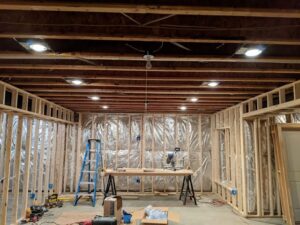
Why Basement Wiring Is Different
Basements are not just another floor. They have conditions that call for extra care:
- Moisture and humidity: concrete walls and floors can hold moisture, which is hard on wiring and devices.
- Low ceilings and tight spaces: ducts, plumbing and beams limit where wiring and lights can go.
- Concrete and block walls: running wire requires planning, furring strips or conduit.
- Higher electrical demand: a finished basement often adds a bedroom, a rec room, a bathroom, a laundry area or a kitchenette, which means more circuits.
- Flood risk: sump pumps and low-lying outlets need careful planning and dedicated protection.
Basement wiring should be planned before drywall goes up, because it’s far cheaper to run wiring while the walls are open than to cut them open later.
Planning a Basement Wiring Project
A well-wired basement starts with a plan. Before work begins, think through:
- How you’ll use the space. A home theatre, gym, home office, rental suite and kids’ play area all have different power and lighting needs.
- Your panel capacity. Adding a basement can push an older 60 or 100 amp panel past its limit. We’ll check whether your service can handle the added load or whether an upgrade makes sense.
- Outlet and switch placement. Think about where furniture, TVs, desks and appliances will go, so you aren’t running extension cords later.
- Lighting design. Pot lights, surface-mounted fixtures and under-cabinet lighting all need to be planned around ducts and joists. Layered lighting makes a basement feel brighter and less like a basement.
- Dedicated circuits. Items such as a bathroom, laundry, freezer, sump pump, heater or kitchenette appliance may need their own circuits.
- Future needs. It costs little to add a few extra conduit runs, network cable or a spare circuit now, and a lot to add them later.
- Smoke and carbon monoxide alarms. These must meet current requirements, and are best planned as part of the wiring.
Ontario Rules, Permits and Inspections
In Ontario, electrical work is governed by the Ontario Electrical Safety Code and overseen by the Electrical Safety Authority (ESA). In general:
- Electrical work requires a permit, or a notification filed with the ESA.
- A licensed electrical contractor files the notification and arranges inspection, then your work is inspected by an ESA inspector.
- Unpermitted work can create problems when you sell your home, renew insurance or file a claim, and it may need to be opened up and redone.
- The Code sets rules for where GFCI and AFCI protection is required, outlet spacing, wire sizing, grounding and more.
Homeowners are permitted to do some work on their own home in Ontario under a homeowner permit, but the work must still pass inspection. Because the rules change, check the ESA’s current requirements or ask a licensed electrician before starting. If you’re unsure, hiring a licensed contractor is the simplest way to get it right.
Common Wiring Issues in Older Hamilton Area Homes
Hamilton, Dundas, Stoney Creek and the surrounding communities include many older homes. Depending on when your house was built, you may find:
- Knob-and-tube wiring: an older system found in some pre-1950s homes. It was not designed for modern electrical loads, and some insurers will not cover homes with it.
- Aluminum branch wiring: used in some homes built in the 1960s and 1970s. It requires special connectors and careful handling.
- Ungrounded outlets: two-prong outlets that lack a safety ground.
- Undersized panels: 60 amp panels or fuse boxes that struggle to power modern homes.
- Overloaded circuits: too many lights, outlets or appliances on one breaker.
- DIY work that doesn’t meet Code, such as loose splices, missing junction box covers or undersized wire.
Some of these are fixable with targeted repairs. Others are best addressed with a rewire or panel upgrade. A licensed electrician can inspect your home and tell you which.
Warning Signs You Need an Electrician
Don’t ignore these signs:
- Breakers that trip repeatedly
- Lights that flicker or dim when appliances start
- Outlets or switches that are warm, discoloured or buzzing
- A burning smell near outlets or the panel
- Outlets that don’t work, or that spark when you plug something in
- Two-prong outlets or no outlets in rooms you use
- A fuse box or panel that is rusted, hot or crowded
- Extension cords used as permanent wiring
If you smell burning or see smoke or sparks, turn off power at the main breaker if it’s safe to do so and call 911 if there’s a fire. Then call an electrician.
Why Hire a Licensed Electrician?
To hire a professional is to protect your family and your investment. A licensed electrician brings:
- Safety: proper materials, protection devices and workmanship that meet Code.
- Permits and inspection: we handle the paperwork and the ESA process.
- Efficient planning: fewer surprises, fewer change orders and less rework.
- Insurance and accountability: licensed, insured contractors stand behind their work.
- Peace of mind: it’s done right, and you can prove it when you sell.
Our Residential Electrical Services
Relief Energy provides electrical services to homeowners across Hamilton and the surrounding area, including:
- Basement wiring and finishing: complete electrical for new and renovated basements, including lighting, outlets, bathrooms and rec rooms
- Electrical panel upgrades: moving from 60 or 100 amp service to 200 amp to power modern homes
- EV charger installation: Level 2 home charging, installed safely and to Code
- Outlet, switch and light repair or replacement: including fixing outlets that don’t work
- Fan installation: bathroom fans, range hood fans and ceiling fans
- Pot lights and lighting upgrades: indoor and outdoor
- Troubleshooting: tripping breakers, flickering lights and dead circuits
- Small electrical jobs: the repairs that don’t fit anywhere else, done properly
We serve Hamilton, Stoney Creek, Ancaster, Dundas, Waterdown, Grimsby and nearby communities.
Need an Electrician in Hamilton? Let’s Talk.
Whether it’s a full basement, a panel upgrade or a repair that won’t wait, Relief Energy is ready to help. We’ll give you honest advice, a clear quote and work that meets code.
Request a quote: call us at , email or fill out our request-service form.